
Attributing Output When Two Rigs Share One Account
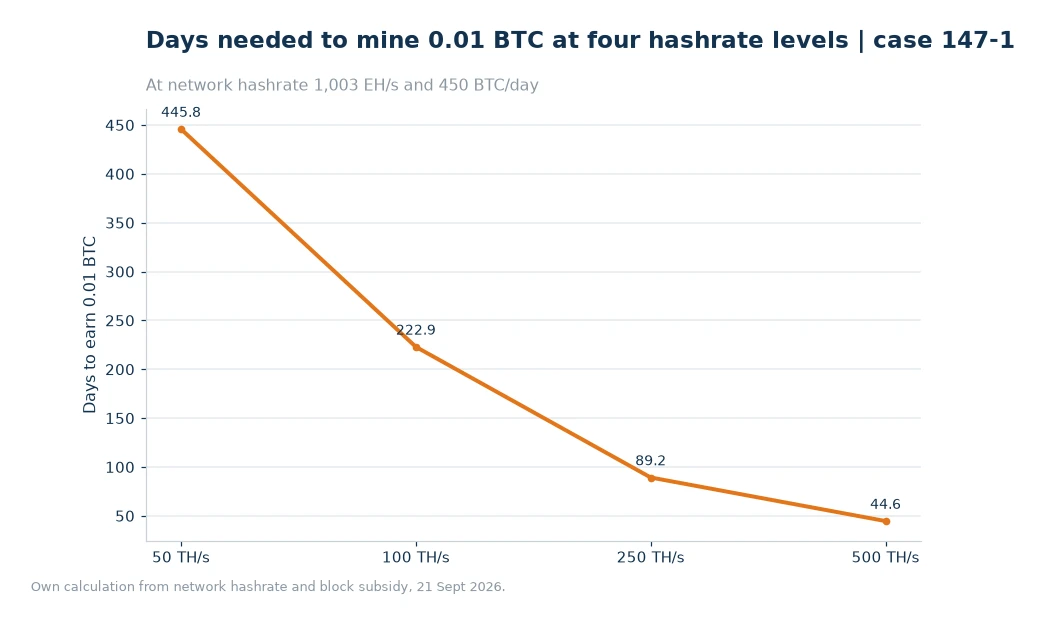
A single pool account with two machines on it produces a total that answers no useful question. Which rig paid for its power this month? Which one is underperforming? Splitting the account by worker name fixes that, and a target amount gives the split a purpose. At current difficulty 0.01 BTC takes 445.8 days on a 50 TH/s unit, 222.9 days on 100 TH/s, 89.2 on 250 TH/s and 44.6 on 500 TH/s.

Key takeaways
- 0.01 BTC takes 445.8 days at 50 TH/s and 44.6 days at 500 TH/s, a tenfold difference in the same account.
- Worker names, not machine serial numbers, are what the pool credits separately.
- A per-worker milestone makes an underperforming rig visible within weeks rather than quarters.
- Pool Hashrate moves both shares at once; Pool Luck explains block discovery, not your hourly credit.
One account, two machines, one unhelpful total
The default view of a mining account is a sum. That is the right view for a tax return and the wrong view for operations. If one machine has a failing fan and is running ten percent below its rated speed, the total falls by five percent when two machines share the account, which is inside the range most operators attribute to weather or difficulty. Isolated per worker, the same fault is a ten percent drop on one line and immediately obvious.
Attribution also settles arguments before they start. When a second machine is added to a site, the question of whether it earns its power is best answered by comparing its worker line with its own meter, not by comparing this month's total with last month's. Two machines, two ledgers, one account, and the total becomes a cross-check rather than the primary number.
Why 0.01 BTC works as a unit of account
Small targets are useful because they arrive often enough to be compared. 0.01 BTC is roughly $846.92 at the 21 Sept 2026 price, which is large enough to be worth tracking and small enough that a mid-sized rig reaches it in weeks rather than years. On a 250 TH/s machine the milestone arrives every 89.2 days; on a 500 TH/s machine every 44.6 days.
Use the same target for every worker and the comparison becomes a ranking. The 50 TH/s unit takes 445.8 days and the 500 TH/s unit takes 44.6, which is exactly ten to one, as it should be for identical efficiency. If the observed ratio departs from the rated ratio, the difference is either efficiency, uptime or a configuration error, and each of those has a different fix. Running the numbers through the Profit Calculator first saves you from blaming a machine for what is really a network move.
The milestone also gives the monthly review a natural trigger. Each time a worker crosses 0.01 BTC, note the date and the difficulty on that day. The intervals between crossings become a series, and a series is far easier to interpret than a running total. A rig that took 89 days for its first milestone and 96 for its second is telling you something about the network; one that took 89 and then 112 is telling you something about the rig.
Worker names are the ledger
The pool credits shares against the worker name the machine connects with, so the naming convention is the accounting system. A scheme that encodes site, rack and machine number, such as a short prefix followed by a two-digit index, survives staff changes and reads correctly in an export. Names invented on the day of installation do not.
Write the mapping down somewhere outside the pool. A spreadsheet with worker name, physical location, model, rated hashrate and installation date takes an hour and pays for itself the first time a machine is moved. When a unit is swapped, the name moves with the slot, not with the hardware, which keeps the history continuous. The ViaBTC BTC Mining Pool page is where the aggregate view sits, but the attribution work happens at the worker level in your own records.
What moves both shares at once
Pool Hashrate is the total speed of every machine pointed at the pool, and every worker's percentage is divided by it. When the pool grows, both of your rigs lose share together, which shows up as a proportional drop across all worker lines. That pattern, a uniform percentage fall on every worker, points at the pool or the network rather than at any single machine.
Pool Luck behaves differently. It compares blocks found with blocks expected over a window, and it is the reading that explains why a PPLNS balance moves in lumps. Under PPS+ the hourly credit is paid against current difficulty, so luck does not change what a worker receives; it is context, not income. Knowing which of the two readings explains a change saves a lot of unnecessary hardware investigation.
| Worker class | Hashrate | BTC per day | Days to 0.01 BTC |
|---|---|---|---|
| Small frame | 50 TH/s | 0.00002243 | 445.8 |
| Mid frame | 100 TH/s | 0.00004486 | 222.9 |
| Large frame | 250 TH/s | 0.00011215 | 89.2 |
| Rack unit | 500 TH/s | 0.00022430 | 44.6 |
A 900 TH/s account made of the first three workers plus a 500 TH/s unit would show four lines with very different milestone dates, and that spread is the useful part of the report. It tells you which machine is carrying the site and which one is decoration.
Worked example
Take the 250 TH/s worker and check its milestone against the account total.
- Per TH/s per day: 450 ÷ 1,003,000,000 = 0.00000044865 BTC.
- At 250 TH/s: 250 × 0.00000044865 = 0.00011215 BTC a day.
- Days for 0.01 BTC: 0.01 ÷ 0.00011215 = 89.17, rounded to 89.2.
- Hourly credit for the worker: 0.00011215 ÷ 24 = 0.00000467 BTC.
- Value of the milestone: 0.01 × 84,692 = $846.92.
- If the account also holds a 50 TH/s unit, that worker needs 445.8 days for the same 0.01 BTC, so it will cross the line once for every five crossings by the 250 TH/s machine.
- Sum the daily figures to check the account: 0.00011215 + 0.00002243 = 0.00013458 BTC a day, which matches the observed total when both workers are healthy.
That final check is the routine worth building. Sum the worker lines, compare with the account total, and investigate any gap before it becomes a habit.
Frequently asked questions
How do I separate two machines in one pool account?
Give each machine its own worker name and read the per-worker hashrate and credit history. The account total is then a check rather than the only figure.
How long does 0.01 BTC take on a small rig?
At 50 TH/s it takes 445.8 days; a 100 TH/s machine halves that to 222.9, and a 250 TH/s machine brings it to 89.2 days.
Why did both workers drop by the same percentage?
That pattern points at Pool Hashrate or difficulty rather than at the hardware; a single machine's fault shows up on one worker line, not across all of them.
Make the split a monthly habit
Export the worker table once a month, put it beside the meter readings and write one sentence per machine. Two of those sentences will be boring and one will occasionally be the most valuable paragraph of the month. The exercise takes twenty minutes and replaces a lot of guessing about which unit is worth keeping powered.
Keep the milestone target fixed for a year so the ranking is comparable, and note the network difficulty you used at each close. If the target moves every month, the trend disappears. The Statistics page gives the network context for those notes, and a simple record of worker name, date, cumulative BTC and difficulty is enough to show whether the account is behaving as its machines should.
Sources: ViaBTC pool state and statistics pages for network inputs, plus the fee page for the listed 4% on the PPS-settled block reward[1]. The snapshot of 21 Sept 2026 recorded difficulty 132.76 T, roughly 1,003 EH/s of network hashrate, 144 blocks a day at 3.125 BTC each and BTC $84,692. Readings are from 21 Sept 2026; publication followed on 24 Oct 2026.